Does spruce weed killer actually kill weeds for good?
Worth it, for spot treatment and safety around pets
Why the driveway weeds keep winning
You're crouched at the driveway edge with the old jug of concentrate, doing the mixing-ratio math in your head, and the dog is sniffing around your boots the whole time. The crabgrass in the crack doesn't care what's in the bottle, it just keeps coming back every June. What you actually want is something you can point and spray without turning the shed into a chemistry bench, and without worrying what's still on the ground when the dog goes back out there.
How spruce weed killer actually works on a leaf
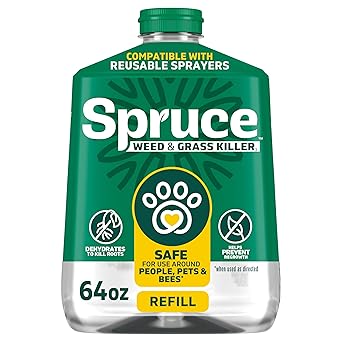
Spruce skips the mixing step because the refill jug is already ready to spray, it just tops up the sprayer you already own. That part's simple. The interesting part is what's actually in it: sodium lauryl sulfate, geraniol, and cornmint oil, none of which are glyphosate. Sodium lauryl sulfate is a surfactant, the same family of stuff that breaks down grease, and here it strips the waxy coating on a leaf's surface. Once that coating is gone, the geraniol and cornmint oil, both fast-acting plant oils, go to work drying the exposed tissue out from the outside in. You'll see it happen within hours, leaves browning and curling like they've been scorched, because that's essentially what's happening. What this mechanism does not do is travel down into the root the way a systemic herbicide does. It kills what it touches on the surface and stops there. For a young dandelion or a crabgrass seedling poking through a driveway crack, that's enough, the whole plant is thin enough to die back fully. For an established, deep-rooted perennial that's been building underground reserves for a few seasons, the top growth burns off and the root often pushes new growth back within a couple weeks. That's also why it's comfortable around pets and kids once it's dried: there's no residual systemic chemical sitting in the soil doing slow work, it's already spent its job on the leaf surface.
You're not buying a lawn-wide weed eradication program here, you're buying a fast burn-down for the weeds you can point at: cracks, edges, mulch beds, the odd dandelion in the yard. Match the tool to that job and it earns its keep every time you use it.
Who spruce weed killer is for, and who should skip it
Worth it if
- you're treating cracks, edges, or mulch beds rather than a whole overrun lawn
- you want a pet and kid safe option once it's dried
- you'd rather not mix concentrate and measure ratios
- you're dealing with young annual weeds or seedlings, not established perennials
Skip it if
- you need one pass to kill an established, deep-rooted perennial weed
- your lawn has a widespread crabgrass or weed takeover, not spot patches
- you want a systemic herbicide that works below the surface like Roundup
Skip it if you're trying to clear an established, root-deep weed takeover in one pass.
The spruce weed killer verdict
If your weed problem is a few stragglers in the driveway or mulch bed and you'd rather not have a systemic chemical drying in the grass where the dog rolls around, this is a quiet yes. If you're staring down a lawn that's gone half over to crabgrass or a perennial weed that's been established for a couple seasons, one pass with this won't finish that job, you'll be back out there with the sprayer again in two weeks.
Picture the actual chore this replaces: no more standing over a mixing jug doing ratios, no more herding the dog inside before you spray. You point, you spray the crack or the mulch bed edge, and by afternoon the leaf's already curling brown. Across the couple thousand ratings this one's picked up, the pattern people describe lines up with the mechanism itself: quick visible results on the small stuff, with reapplication expected on anything with real roots behind it. That's not a flaw to wait out, it's just what the bottle is built to do.
Amazon shoppers rate it 4 out of 5 across 2,938 ratings. That is their number, not ours.
Before you go
Does the weed killer spruce really work?
Yes, it works on contact within hours, but kills young weeds while established perennials often need repeat treatments.
Is spruce weed killer as good as Roundup?
No, they work differently. Spruce burns leaf surface for faster results on small weeds; Roundup is systemic, better on established ones.
What is the main ingredient in spruce weed killer?
The active ingredients are sodium lauryl sulfate, a surfactant that strips the waxy coating on leaves, along with geraniol and cornmint oil, two fast-acting plant oils that dry out the exposed tissue.
Does vinegar, salt, and dawn really kill weeds?
Yes, on the same principle as Spruce—surface burn kills small weeds but rarely finishes established roots, so expect similar reapplication needs.
By the numbers
earn an unconditional yes at full priceOut of 119 lawn & garden products we have reviewed. This one is a yes with a condition attached.
other reviews field the same questionDoes the weed killer spruce really work?
comes up across our lawn & garden coverage, not just here — one of the things worth settling before you choose.
Verdict datasetQuestion indexCC BY 4.0
Full spec sheet
| Brand | Spruce |
|---|---|
| Item Weight | 4.3 pounds |
| Liquid Volume | 64 fluid ounces |
| Item Form | Spray |
| Active Ingredients | Sodium Lauryl Sulfate, Geraniol, Cornmint Oil |
Keep comparing



More lawn & garden reviews.