Why a fallen limb makes you second-guess a gas chainsaw
A storm drops a limb across your driveway and the bow saw in your garage turns into an hour of burning forearms and a blister you'll feel for a week. You start eyeing something with a motor, and the question that stops you at the shelf is whether Troy-Bilt chainsaws are any good or just a name on a box sitting next to the real professional saws. The bar looks the right size, the price looks fair, and none of that tells you what happens on the first pull.
How the Troy-Bilt TB4218's engine and SpringAssist starter actually work
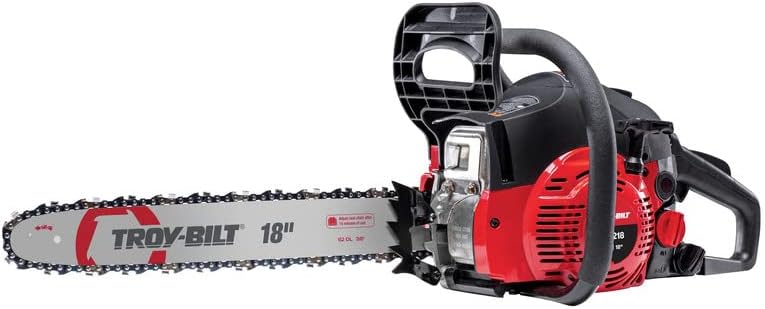
Here's what's actually happening under the cowling. The TB4218 runs a 42cc, full crank two cycle engine, the same basic layout every gas chainsaw uses: fuel and oil mixed together, burned in short violent bursts, turning a crankshaft that spins the chain. Full crank matters because it supports the crankshaft on both ends instead of one, which is what keeps a small engine from shaking itself loose over years of use. SpringAssist is the one clever bit worth understanding. Instead of your arm alone fighting the engine's compression on every pull, a spring inside the starter absorbs some of that resistance and hands it back into the pull, so the rope comes out shorter and lighter. That's the difference between one clean yank and five frustrated ones, and it's where most frustration with gas saws actually starts, at the cord, not the cutting. The 18 inch bar is sized for limbs and small trunks, not felling old growth, and it's a low kickback design, meaning the cutting teeth are shaped to reduce the chance of the bar snapping back at your face when the tip catches something it shouldn't. An automatic oiler keeps the bar wet with lubricant as you cut, so you're not stopping every ten minutes to hand oil it, and the inertia activated chain brake stops the chain in a fraction of a second if the saw jerks upward. At fifteen and a half pounds with three point anti vibration handles, it's light enough that your arms absorb less of the shake, cut after cut.
So the real trade here isn't power, most homeowner gas saws have plenty for storm limbs and firewood rounds. What you're actually paying for is a starter that doesn't fight you and a bar built to cut the odds of kickback. Worth it if you're willing to run it like a small engine, meaning fresh fuel mix and basic care, not like an appliance you plug in and forget.
Who the Troy-Bilt TB4218 chainsaw is for, and who should skip it
Worth it if
- you cut firewood or clear storm limbs a few times a season
- you're willing to keep fresh fuel mix and basic engine care in rotation
- you want lower pull effort than a standard recoil starter
- you need a saw sized for limbs and small trunks, not felling
Skip it if
- you want an appliance that starts every time with zero engine upkeep
- you're doing heavy, daily, or professional-grade cutting
- ethanol fuel, carb cleaning, and seasonal storage aren't things you want to manage
Not for anyone who wants zero-maintenance, start-every-time reliability without thinking about fuel or storage.
Are Troy-Bilt chainsaws any good, the honest verdict
If you clear storm limbs or cut firewood a few times a season, and you don't mind learning the small habits of a two cycle engine, this is a quiet yes at its price. If you want something that starts every single time without a thought, whatever the season, a battery saw or a pricier professional model will treat you better. A year from now is the real test of any gas tool, and that mostly comes down to how it's stored, not how it was built.
Once it's running, the job that used to eat your whole evening with a bow saw is done before you've broken a sweat, the bar biting through a fallen limb in a few clean passes instead of twenty tired ones. Day one is mostly the pull cord and the fuel mix, get both right and the rest of the cut is easy. Keep a spare spark plug and fresh fuel on hand and most of the starting frustration people worry about never shows up.
Amazon shoppers rate it 4 out of 5 across 47 ratings. That is their number, not ours.
Before you go
Who manufactures Troy-Bilt chainsaws?
Troy-Bilt is a brand under MTD Products, and this saw's 42cc two cycle engine is built in-house rather than sourced from an outside engine maker like Honda or Kohler.
Which chainsaw is better, Troy Built or Stihl?
Stihl sits a tier up in build quality, parts availability, and dealer support, and it costs more for that; Troy-Bilt is homeowner-grade gear that handles occasional yard work well but isn't built for daily or professional use.
Who makes the most reliable chainsaws?
Professional-grade brands like Stihl and Husqvarna hold the strongest reputation for long-term reliability, largely because their engines and parts networks are built around daily commercial use rather than occasional homeowner tasks.
What brand engine does Troy-Bilt use?
Troy-Bilt builds its own two cycle engines rather than licensing one from another manufacturer, and the TB4218 uses their 42cc full crank version with SpringAssist for an easier pull start.
By the numbers
earn an unconditional yes at full priceOut of 113 lawn & garden products we have reviewed. This one is a yes with a condition attached.
Verdict datasetQuestion indexCC BY 4.0
Full spec sheet
| Model Number | 41AY4218766 |
|---|---|
| Brand Name | Troy-Bilt |
| Unit Count | 1 Count |
| Number of Items | 1 |
| Included Components | (1) 42cc Low Kickback 18" Gas Chainsaw-TB4218; (1) 2-Cycle Engine Oil |
| Item Type Name | Chainsaw |
| Manufacturer Part Number | 41AY4218766 |
| Power Source | Gas Powered |
Keep comparing


More lawn & garden reviews.