Is the Gskyer Telescope Worth It for Beginners?
Worth it, if you're the right kind of beginner
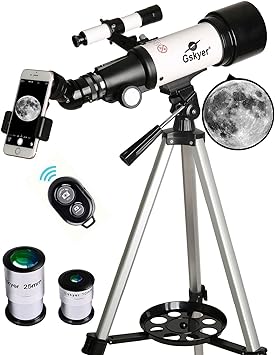
Picture the moon just cleared the fence line, the kids are hopping with impatience, and you finally get an eye to the eyepiece, only to find a fuzzy grey smear instead of craters. That gap between the box photo and the real view is exactly what a gskyer telescope review needs to settle before you spend anything: will this actually show you something worth looking at, or just gather dust in the closet.
Here's what actually determines what you'll see: the 70mm aperture, not the magnification number printed on the box. Aperture is the front lens's diameter, and it's the bucket that catches light; a bigger bucket means the moon looks bright and sharp instead of dim and grainy. The 400mm focal length combined with the included eyepieces sets your baseline magnification, and the 3x Barlow lens triples whatever the eyepiece delivers, genuinely useful for close-ups of the moon but limited: past a certain power, a small aperture like this one just shows a bigger, blurrier smear, not a clearer planet. The part that quietly makes or breaks the whole experience is the little 5x24 finder scope. It has crosshairs and its own mount, and aligning it with the main tube in daylight, before dark, is what determines whether you find anything at all once the sun goes down. Skip that step and you'll spend twenty frustrating minutes swinging the tube at empty sky. The phone adapter and wireless remote solve a different problem: they let you snap a photo without your hand shaking the rig, turning a fleeting look at Saturn into something you can actually show someone.
So you're not buying a device that turns you into an astronomer overnight, you're buying a low-stakes way to learn how to actually find things in the sky, with a phone photo as proof you found them. The optics are honest for the aperture size: the moon and bright planets look genuinely good, deep sky objects will stay smudges no matter which eyepiece you use.
Worth it if
- You have a curious kid or beginner wanting to explore the moon and bright planets
- You're willing to align the finder scope in daylight before the first night session
- You want a phone-photo souvenir more than pro-grade detail
Skip it if
- You're expecting crisp views of Saturn's rings or Jupiter's bands
- You've already outgrown beginner gear
- You don't want to spend time on setup and alignment
Not for anyone expecting detailed planetary views or telephoto-grade astrophotography.
If you've got a curious kid and you're willing to spend one daylight session aligning that finder scope before the first night out, this is a quiet yes. If you're picturing Jupiter's bands or Saturn's rings in crisp detail, save up for something with a bigger aperture instead, because no amount of eyepiece swapping gets you there on 70mm.
Amazon shoppers rate it 4 out of 5 across 22,033 ratings. That is their number, not ours.
Before you go
Is Gskyer a good telescope brand?
Yes, for beginners at this price point. The optics match the aperture for learning basics, though not for serious astrophotography.
Can you see planets with a Gskyer telescope?
Yes, you can see the moon's craters clearly and Jupiter and Saturn as bright shapes, but not their fine detail.
Why can't I see anything out of my Gskyer telescope?
Almost always it's the finder scope, if it isn't aligned with the main tube in daylight first, you'll be aiming blind once it's dark.
By the numbers
camera & photo products reviewedThis one is a yes with a condition attached.
other reviews field the same questionIs Gskyer a good telescope brand?
comes up across our camera & photo coverage, not just here — one of the things worth settling before you choose.
Verdict datasetQuestion indexCC BY 4.0
Full spec sheet
| Brand | Gskyer |
|---|---|
| Model Name | Astronomical Refracting |
| Optical Tube Length | 40 centimeters |
| Eye Piece Lens Description | Barlow |
| Objective Lens Diameter | 7 centimeters |
| Telescope Mount Description | Altazimuth Mount |
| Product Dimensions | 24.8"D x 4.92"W x 8.46"H |
| Focus Type | Manual Focus |
Keep comparing



More camera & photo reviews.