Is the Dianfan Telescope Worth It for a Beginner Stargazer?
Worth it, if you want the moon and not the nebulae

Picture standing in the backyard after dark, tripod legs sinking into cold grass, one eye squeezed shut against the eyepiece while you hunt for the moon you promised would look incredible. Most cheap telescopes fail right here, at the moment your hands are shaking the view around and nothing lines up. That's the real test of a dianfan telescope, or any telescope in this price range: not the number on the box, but what actually shows up in the eyepiece.
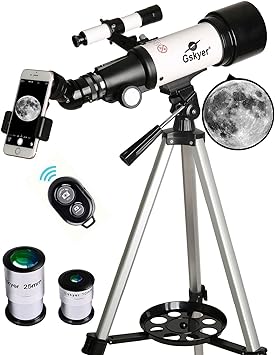
Here's the part the listing leads with backwards. The headline number is 240x magnification, but magnification is the least important spec on this telescope. What actually matters is the 90mm aperture, the diameter of the front lens, because aperture determines how much light the scope can physically gather. More light in means a brighter, sharper image, and there's a rough ceiling on usable magnification of about twice the aperture in millimeters, so this scope tops out around useful clarity well before 240x, where the image just gets bigger and dimmer, not better. The 800mm focal length and the two eyepieces plus 3x Barlow lens give you a working range from wide, bright views down to tight lunar craters, and the 45-degree zenith mirror flips the image upright, which is the difference between a telescope you can actually aim at a bird on a fence and one that only makes sense pointed straight up. The stainless tripod's job is just to hold still long enough for any of that to matter.
So you're not buying magnification, you're buying light. A 90mm lens gathering light is what turns a shaky blur into a crisp view of craters or Saturn's shape, and that's the whole trick this size of scope can and can't do.
Worth it if
- You mainly want to look at the moon, planets, and bright objects
- You want something a beginner or family can set up in about 15 minutes
- You'd rather travel light than own something bulky and permanent
Skip it if
- You're chasing detailed views of nebulae or distant galaxies
- You want to trust the 240x number as the main selling point
- You need a scope built for serious astrophotography
Not for anyone expecting deep-sky detail on faint, faraway objects, that needs a bigger aperture than this class of scope offers.
If you want a telescope that shows the moon's seas and craters clearly and gets a family outside on a clear night, this is a quiet yes. If you're chasing detailed views of distant nebulae or galaxies, an aperture this size runs out of light before you get there, and no amount of magnification fixes that.
Amazon shoppers rate it 4 out of 5 across 799 ratings. That is their number, not ours.
Before you go
How to use a Dianfan telescope?
Set up the tripod, attach the optical tube, start with the lowest-power eyepiece to locate your target, then switch to a higher-power eyepiece or add the Barlow lens once it's centered.
What telescope can see Saturn's rings?
A 90mm aperture scope like this one can show Saturn as a distinct shape with rings on a clear night, though fine ring detail improves with larger apertures.
What to avoid when buying a telescope?
Avoid judging a telescope by its magnification number alone, since aperture (the front lens diameter) is what actually determines brightness and real image quality.
By the numbers
camera & photo products reviewedThis one is a yes with a condition attached.
Verdict datasetQuestion indexCC BY 4.0
Full spec sheet
| Brand | Dianfan |
|---|---|
| Model Name | 90800 |
| Optical Tube Length | 80 centimeters |
| Eye Piece Lens Description | Kellner |
| Objective Lens Diameter | 9 centimeters |
| Telescope Mount Description | Altazimuth Mount |
| Product Dimensions | 31"D x 11"W x 5"H |
| Focus Type | Manual Focus |
Keep comparing


More camera & photo reviews.