Is the ZELUS weighted vest worth adding to your workouts?
Worth it, but only once you know your weight
Why plate vests bounce and dig in
You're mid-interval, lungs burning, and a stiff plate vest is knocking against your collarbone with every stride, straps sawing at your shoulders. You cinch it tighter and it still shifts. That's the moment most people start looking at a zelus weighted vest instead, wondering if sand beats steel plates for something you actually have to move in.
How the ZELUS weighted vest actually spreads the load
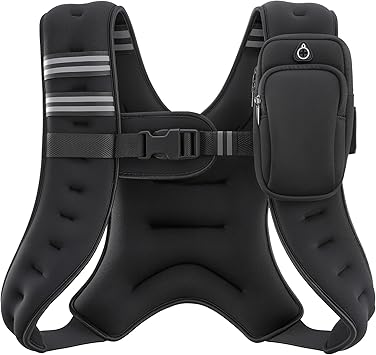
Here's what's actually different once you open the box: instead of hard plate pockets, ZELUS pours iron sand into evenly stitched channels across the front and back panels. Sand has no sharp edges to dig into your ribs, and because it's packed into dozens of small compartments rather than two big plates, the weight settles against your torso instead of swinging off it when you jump or twist. That's the mechanism behind this holding up for rope skipping and interval running, not just a slow walk.
The adjustable buckle straps do the rest of the job: they stretch to fit chests from 31.5 to 45 inches, so the same vest that fits a lean runner also cinches down on a broader frame without the load sliding to one side mid-set. Spandex panels flex with your shoulders instead of fighting them, and the small armband pouch plus rear mesh pocket mean your phone or keys ride along instead of bouncing loose.
The one catch worth knowing before you buy: the weight is sewn in, not stackable. You're choosing a fixed 6, 8, 12, 16, 20, 25 or 30 pound vest, not a shell you load up gradually. Pick 12 pounds and decide in six months you want 20, and you're buying a second vest, not adding plates to this one.
So the real decision isn't vest versus vest, it's pound versus pound: you're not buying a weighted vest, you're buying a specific, permanent number stitched into spandex, and the vest just happens to be the delivery method. Get that number right for your current fitness and this is a low-profile, snug way to load bodyweight work. Get it wrong and no strap adjustment fixes it.
Who the ZELUS weighted vest fits, and who should skip it
Worth it if
- you already know the target weight you want to train with
- you want a low-profile vest that stays put during running or jumping
- you need a strap system that fits a wide range of chest sizes
- you're doing interval, circuit or rope-skipping work rather than max-load lifting
Skip it if
- you want to add or remove weight as you get stronger
- you need loads heavier than 30 pounds
- you'd rather have a removable plate carrier for customization
- you run hot and don't want a sand-filled panel trapping heat
Skip it if you want to add weight gradually over months, since this vest's poundage is fixed for good.
The ZELUS weighted vest review verdict
If you already know roughly what weight you want to train with, and you're after something that stays put during runs, rope skipping or strength circuits, this is a quiet yes. If you're the type who likes to add weight every few months as you get stronger, skip it and look at a plate-loaded vest instead, because this one doesn't grow with you.
The problem this solves is the one from the first stride: no more plate corners digging in, no more vest sliding sideways mid-jump. Day one probably looks like clipping it on for an easy run just to feel the sand settle against your back, then forgetting it's there by minute ten. With well over sixteen thousand ratings behind it, a big share of buyers land on the same thing: cinched down correctly, the sand load feels steady rather than clunky, which is the whole promise of this design.
Amazon shoppers rate it 4 out of 5 across 16,816 ratings. That is their number, not ours.
Before you go
Does wearing a weighted vest really work?
Yes, added resistance from a fixed-weight vest makes bodyweight movements like walking, running or squats harder, which is the basic mechanism behind strength and conditioning gains.
How to properly wear a Zelus weighted vest?
Cinch the buckle straps snug against your ribs so the sand panels sit flat against your torso instead of swinging, then tighten shoulder straps until it stops shifting when you jog in place.
What is the downside of a weighted vest?
The weight is sewn in and fixed at purchase, so you can't add or remove pounds as you get stronger, and sand-filled panels trap more heat than an open plate carrier.
Are Zelus weighted vests good?
Yes, if you pick the correct pound rating for your fitness level, since the adjustable straps and distributed sand fit a wide range of chest sizes comfortably.
By the numbers
earn an unconditional yes at full priceOut of 160 sports & outdoors products we have reviewed. This one is a yes with a condition attached.
Verdict datasetQuestion indexCC BY 4.0
Full spec sheet
| Size | 12lb |
|---|---|
| Brand | ZELUS |
| Material | Iron Sand, SBR, Spandex |
| Color | Black |
| Style | Modern |


