Are Nikon Monarch M7 binoculars worth the money?
Worth it, if low light is a regular problem for you
Why birds disappear right before dark
You're at the tree line at last light, glass to your eyes, and the bird you're tracking has already gone gray at the edges. Color fringes purple around the branches, the image softens the moment the sun drops behind the ridge, and you're left guessing at species instead of actually seeing them. That's the moment nikon binoculars either earn their price or don't: the last twenty minutes before it's technically too dark to see anything at all.
How Nikon Monarch M7 binoculars actually get brighter
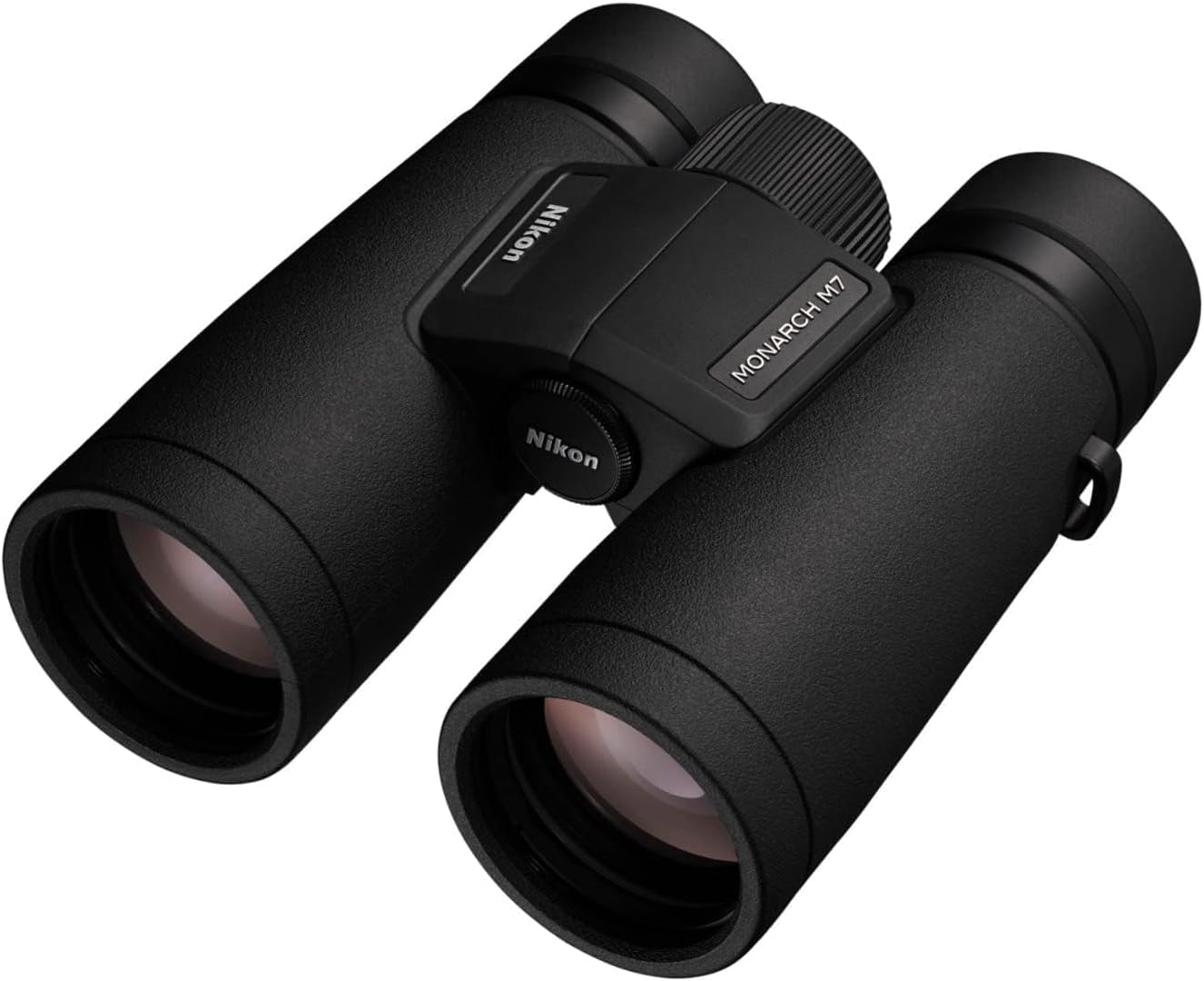
Here's where your money actually goes. Cheap roof-prism binoculars split light into two phases when it bounces off the prism, and if that's not corrected the image loses a meaningful chunk of contrast and sharpness compared to an older porro design. Nikon coats the prism with a phase correction layer specifically to put that light back in sync, which is the real reason the image looks crisp rather than just magnified. Then there's the glass itself: ordinary optical glass bends different wavelengths by different amounts, which shows up as that purple or green fringe around high-contrast edges, like a bird against bright sky. Extra-low dispersion glass elements correct for that at the source, so the fringe mostly disappears instead of just getting cropped out of your attention. Add dielectric coating on the prism, which reflects around 99 percent of light instead of the 85 to 90 percent you get from plain aluminum coating, and the practical result is a noticeably brighter image at the exact moments there isn't much light to spare, dawn and dusk. The locking diopter is a small detail that solves a real annoyance: without a lock, the ring that balances your two eyes drifts if it brushes a jacket sleeve, and you spend the walk refocusing instead of watching anything. Lock it once per user and it stays put. The 16.5mm of eye relief matters if you wear glasses, since it's roughly how far back your eye can sit and still see the full image. None of this changes what the binoculars fundamentally are. It changes what you can still see once the light starts running out.
So you're not paying for 10x magnification, cheap pairs do that too. You're paying for the last twenty minutes of usable light and for how much color survives once it gets there. If that window doesn't come up much in your life, the spec sheet is just numbers.
Who the Nikon Monarch M7 is for, and who should skip it
Worth it if
- you regularly glass in the last hour of light before dark
- you wear glasses and need real usable eye relief
- you want a diopter setting that won't drift on you
Skip it if
- you only use binoculars in full daylight
- you're an occasional user who takes them out a few times a year
- you want the lightest possible pair for long hikes
If you only ever glass in bright daylight or use binoculars a handful of times a year, this is more binocular than your habits need.
The Nikon Monarch M7 binoculars verdict
If low light is a regular problem, dawn walks, dusk birding, a hunting stand where the real sighting happens right before dark, this is a quiet yes. If you mostly glass in full daylight or take a pair out twice a summer, a cheaper set will show you the same bird just fine and you won't notice what you didn't pay for.
Picture the next low-light session: the bird doesn't dissolve into a gray blob the second the sun dips, the edges stay defined, and you're not squinting to guess at markings you can't quite resolve anymore. That's the whole purchase, not new features, just more of the available light actually reaching your eye. None of that changes if you wait a week to decide, so there's no reason to rush it, only to buy once you're sure it's the low-light hour that's actually been bothering you.
Amazon shoppers rate it 4.6 out of 5 across 232 ratings. That is their number, not ours.
Before you go
Are Nikon binoculars good quality?
Yes, Nikon's optics use the same coating and glass technology across their lineup, and the Monarch line specifically adds phase correction and dielectric coating that lower-tier binoculars skip.
Which are the best Nikon binoculars?
For most people the Monarch M7 hits the balance point, since it carries the same ED glass and phase-corrected prisms as Nikon's higher tiers at a lower price.
Does Nikon make binoculars anymore?
Yes, Nikon still manufactures and actively sells several binocular lines including the Monarch, Prostaff and Aculon series.
Which binoculars are better, Nikon or Bushnell?
Both make capable optics, but Nikon's Monarch tier generally edges ahead on low-light brightness and color correction at a comparable price point, while Bushnell's comparable lines tend to compete more on price.
By the numbers
camera & photo products reviewedThis one is a yes with a condition attached.
other reviews field the same questionAre Nikon binoculars good quality?
comes up across our camera & photo coverage, not just here — one of the things worth settling before you choose.
Verdict datasetQuestion indexCC BY 4.0
Full spec sheet
| Features | Extra-Low Dispersion Glass Elements; Lead- and Arsenic-Free Eco-Glass; Phase-Corrected … |
|---|---|
| Objective Lens Diameter | 42 millimeters |
| Magnification Maximum | 10 |
| Specific Uses | Bird Watching |
| Mount Type | Tripod Mount |
| Eye Relief | 16.5 millimeters |
| Prism Type | Roof Prism |
| Relative Brightness | 17.6 |
Keep comparing


More camera & photo reviews.