Is a 16X52 Monocular Telescope Actually Worth It?
Worth it, for casual use and gifting
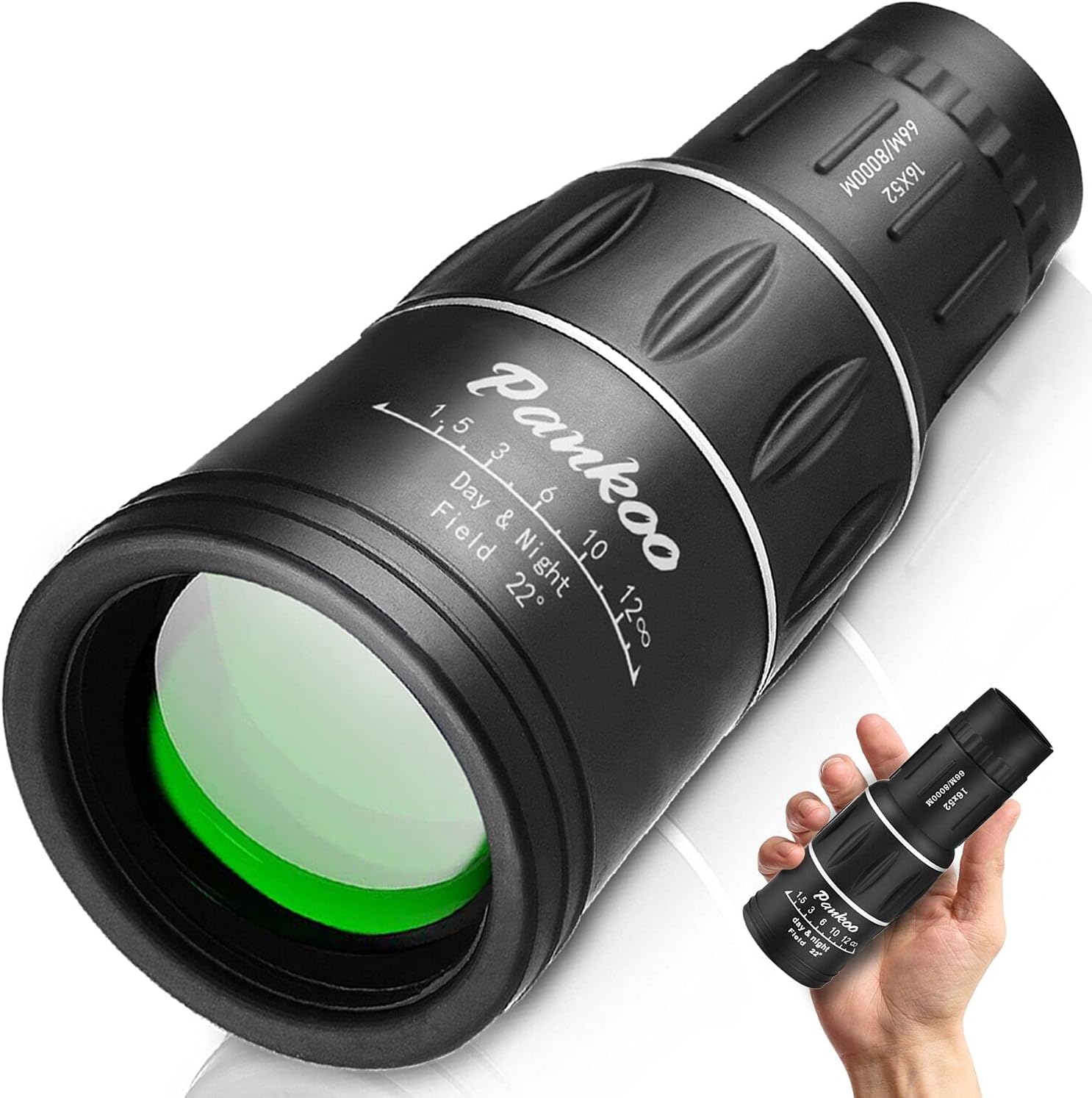
You're on a trail, something moves in a tree across the field, and you squint, trying to decide if it's worth digging your phone out to zoom in. That blurry, half-second decision is exactly what a monocular telescope is supposed to solve, and it's also exactly where cheap ones fall apart, turning a distant bird into a smear of green.
Here's the bit the listing buries under the 16X number: zoom means nothing without light, and light is what actually makes an image usable outdoors. This one uses a 52mm objective lens, which is the front glass, and a bigger lens simply lets in more light than a small one at the same magnification. That's why the spec sheet pairs the zoom with the lens size instead of listing zoom alone. Inside, a BAK-4 prism (the good kind, denser glass, less light lost bouncing around) plus a fully multi-coated lens is what keeps the image from showing that dark ring or black bar around the edges you get with cheaper prisms. The other quiet feature is the nitrogen purge inside the tube. Because the housing is sealed and filled with dry nitrogen instead of regular air, there's no moisture inside to fog up when you go from a warm car into cold, damp morning air, which is the exact moment a lesser monocular clouds over on you.
So you're not really paying for the 16X number on the box, you're paying for how much usable light gets through that lens and whether the tube stays clear when the weather turns. A monocular with big zoom and a small lens or a cheap prism will look great in a sunny backyard and disappoint at dusk on a real hike.
Worth it if
- You want a lightweight, pocketable option for hikes, games, or travel
- You're buying it as a low-cost gift for someone who likes the outdoors
- You mostly view in daylight and want something that survives rain and temperature changes
Skip it if
- You need serious magnification for astronomy or distant wildlife detail
- You already own real binoculars and don't need a backup
- You expect tripod-level steadiness at full zoom, handheld at 16X will shake
Not for anyone expecting telescope-grade detail at real distance, this is a compact grab-and-go tool, not a scientific instrument.
If you want something pocket-sized for hikes, ball games, or handing to a kid without worrying about a big investment, this is a quiet yes. If you're after serious long-range detail for astronomy or true wildlife scoping, a monocular this size and price was never built for that, and you'll want a larger scope or real binoculars instead.
Amazon shoppers rate it 4.3 out of 5 across 8,019 ratings. That is their number, not ours.
Before you go
Are monocular telescopes any good?
Yes, a well-built one with decent prism and lens size gives a clear, bright image for casual daylight use like hiking. Not a substitute for serious optics.
Is a monocular better than a telescope?
No, just different: a monocular is smaller and handheld for quick daytime glances, while a telescope is built for stability and much higher magnification.
What is a good power for a monocular?
Somewhere around 8X to 16X is the practical range for handheld use, since higher zoom without a tripod tends to shake and lose the clear image you're trying to get.
By the numbers
camera & photo products reviewedThis one is a yes with a condition attached.
Verdict datasetQuestion indexCC BY 4.0
Full spec sheet
| Eye Piece Lens Description | Prism |
|---|---|
| Mount | Handheld Monocular |
| Focus Type | Manual Focus |
| Power Source | no need |
| Finderscope | Reflex |
| Coating | Fully Multi-Coated |
| Focal Length Description | 3.5 millimeters |
| Field Of View | 5.8 degrees |
Keep comparing
More Pankoo


More camera & photo reviews.