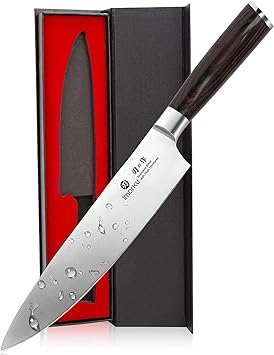
Why a dull knife makes you fight your food
You know that squashed feeling when a chef's knife skids off a tomato skin instead of gliding through it, and you end up sawing back and forth while juice runs down your wrist. That's usually not you, it's the edge. The imarku Japanese chef knife promises to fix exactly that moment, the one where a knife should just disappear into the food instead of fighting it.
How the imarku japanese chef knife's edge actually works
Here's what I'd want to know first: this is a gyuto, the Japanese answer to the western chef's knife, and the shape changes how you actually cut. A gyuto's blade sits flatter along most of its length and the edge is ground thinner, closer to fifteen degrees per side instead of the twenty you'd find on a typical German knife. A thinner edge pushes less steel through the food as it cuts, which is why a sharp gyuto slices a tomato instead of squashing it. The high carbon stainless steel is what lets that thin edge hold its shape, since carbon hardens steel, and harder steel keeps a fine edge longer between sharpenings. That's the trade you're making: a harder, thinner edge cuts cleaner and stays sharp longer, but it's also more likely to chip if it meets a bone, a frozen block, or the inside of a dishwasher. The pakkawood handle, that dense resin-treated wood, is there for balance as much as looks, keeping the weight forward near the blade so the knife wants to fall through food rather than needing muscle behind it. This is the bit the listing buries: the same hardness that gives you that clean, satisfying cut is also what asks you to hand wash it and keep it away from other blades in the drawer. It's not a fragile knife, it's a precise one, and precise tools want a little more care than blunt ones.
So the honest reframe is this: you're not buying a chef's knife, you're buying a thinner angle that lets the blade do the work instead of your arm. That's worth something real if you cook often enough to notice the difference between slicing and sawing.
Who the imarku chef knife is for, and who should skip it
Worth it if
- you're willing to hand wash and dry it after each use
- you want a thinner, sharper edge than typical western knives
- you're buying it as a step up from a basic starter knife or as a gift
Skip it if
- you want a dishwasher-safe knife you never have to think about
- you regularly cut through bone or frozen food with your chef's knife
- you want a knife that forgives being tossed loose in a drawer
Not for anyone who wants a dishwasher-safe knife they never have to think about.
The imarku japanese chef knife verdict
If you're the kind of cook who hand washes their good knives and enjoys keeping an edge sharp, this is a quiet yes, it'll outperform knives twice its price for years. If you want something you can toss in the dishwasher and forget about, save yourself the disappointment and buy a sturdier, duller knife instead.
Picture the first tomato you slice with this instead of sawing through it: the blade just drops in, clean rounds instead of crushed ones, and dinner starts to feel less like a fight. With over ten thousand ratings behind it, the pattern is clear, most people are struck by how sharp it feels straight out of the box and how long that edge holds if you treat it right. Give it a strop now and then and you'll forget what your old knife felt like.
Amazon shoppers rate it 4 out of 5 across 10,430 ratings. That is their number, not ours.
Before you go
Are imarku knives good quality?
Yes, for the price. High carbon steel takes and holds a sharp edge well if hand washed and not twisted on bone or frozen food.
Are imarku knives made in Japan?
No, it's Japanese in design. The gyuto blade shape and steel style are Japanese, but the knife is not made in Japan.
What is considered the best Japanese chef knife?
There's no single answer, but the best Japanese chef knives generally share a thin, hard-steel edge in a gyuto shape, which is exactly the design this knife follows.
What is an imarku knife used for?
It's an all-purpose chef's knife for everyday chopping, slicing and dicing of vegetables, meat, and herbs.
By the numbers
earn an unconditional yes at full priceOut of 266 kitchen products we have reviewed. This one is a yes with a condition attached.
Verdict datasetQuestion indexCC BY 4.0
Full spec sheet
| Blade Material | High Carbon Stainless Steel |
|---|---|
| Brand | imarku |
| Color | brown and silver |
| Handle Material | Pakkawood |
| Blade Edge | Plain |
Keep comparing
More imarku


More kitchen reviews.