Is the Focusrite Scarlett Solo 3rd Gen Worth It?
Worth it, if you only need one input at a time
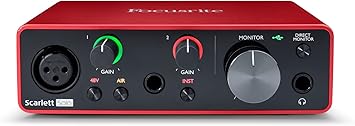
You've probably tried recording a guitar or a vocal straight into your laptop's built-in mic at some point, and it came back sounding like it was recorded inside a tin can, thin, distant, with a hiss riding underneath every note. That gap between what you hear in the room and what comes out of the speaker is the whole reason audio interfaces exist. The Focusrite Scarlett Solo 3rd Gen is built to close exactly that gap, and the question is whether a box this small actually does it.
Here's the actual mechanism. Your microphone or guitar puts out a very small, fragile electrical signal, and a laptop's built-in input isn't designed to boost that signal cleanly, it just amplifies the noise along with it. The Scarlett Solo's XLR mic preamp is a dedicated circuit whose only job is to raise that signal to a usable level without adding much of its own noise, and Focusrite's Gain Halo rings the input knob with color, so you can see clipping before you hear it, instead of finding out after a good take is already ruined. Flip on Air mode and the preamp shifts its frequency response to push a bit more brightness into the upper mids, the trick studios use to make an acoustic guitar or a voice sound closer to the mic instead of trapped behind it. Everything then gets converted at up to 24-bit/192kHz, well above streaming quality, so the file you save holds onto detail a cheaper converter would just throw away. The result is a signal chain that gets out of its own way, which is the entire point of an interface.
You're not buying extra knobs, you're buying a clean signal path, the difference between a recording that sounds like it happened in a room and one that sounds like it happened inside a phone. Once that chain is clean, the guitar or the mic you already own suddenly has somewhere honest to plug into.
Worth it if
- You record one vocal or one instrument at a time
- You want your existing mic or guitar to sound closer and cleaner without buying new gear
- You want bundled recording software to get started without extra cost
Skip it if
- You need to record a band or a two-host podcast simultaneously
- You already own an interface with clean preamps and just want more inputs
- You're recording purely digital instruments with no mic or guitar involved
Not for anyone recording two sources at once, it only has one mic input and one instrument input, and they can't both run at full gain simultaneously in every setup.
If you're recording vocals, guitar, bass or a podcast on a budget and want your existing gear to actually sound like itself, this is a quiet yes. If you need to record two mics or instruments at once, for a band take or a two-host podcast, this isn't your box, look at something with two preamps instead.
Amazon shoppers rate it 4 out of 5 across 29,312 ratings. That is their number, not ours.
Before you go
Is Scarlett Solo 3rd gen good for vocals?
Yes, its single XLR preamp and Air mode are built for that job specifically, adding a brighter, closer-sounding top end that works well on both spoken word and singing.
What's the difference between the Focusrite Scarlett Solo 3rd gen and 4th gen?
The 4th gen adds a second Air mode setting with more harmonic drive and auto-gain, but the core one-mic, one-instrument layout and 24-bit/192kHz converters carry over the same basic idea.
What does the Scarlett Solo 3rd gen do?
It converts one microphone's and one instrument's analog signal into a clean digital recording your computer can use, sitting between your gear and your recording software.
By the numbers
musical instruments products reviewedThis one is a yes with a condition attached.
Verdict datasetQuestion indexCC BY 4.0
Full spec sheet
| Brand | Focusrite |
|---|---|
| Compatible Devices | Microphone, Instrument, Personal Computer, Headphones, Studio Monitors |
| Supported Software | All audio recording software |
| Connectivity Technology | USB |
| Number of Channels | 2 |


