Is the De'Longhi Stilosa espresso machine worth it?
Worth it, with a learning curve
Why milk frothing at home feels harder than it looks
You're standing at the counter in your socks, watching milk crawl up the side of a metal pitcher, waiting for it to turn from liquid to something you could spoon onto a cappuccino. The steam wand hisses, your arm gets tired holding the pitcher at that specific angle nobody explains, and you wonder if a home espresso machine like the De'Longhi Stilosa can actually get you there, or if you just spent real money on a very small, very loud coffee shop prop.
How the De'Longhi Stilosa espresso machine actually works
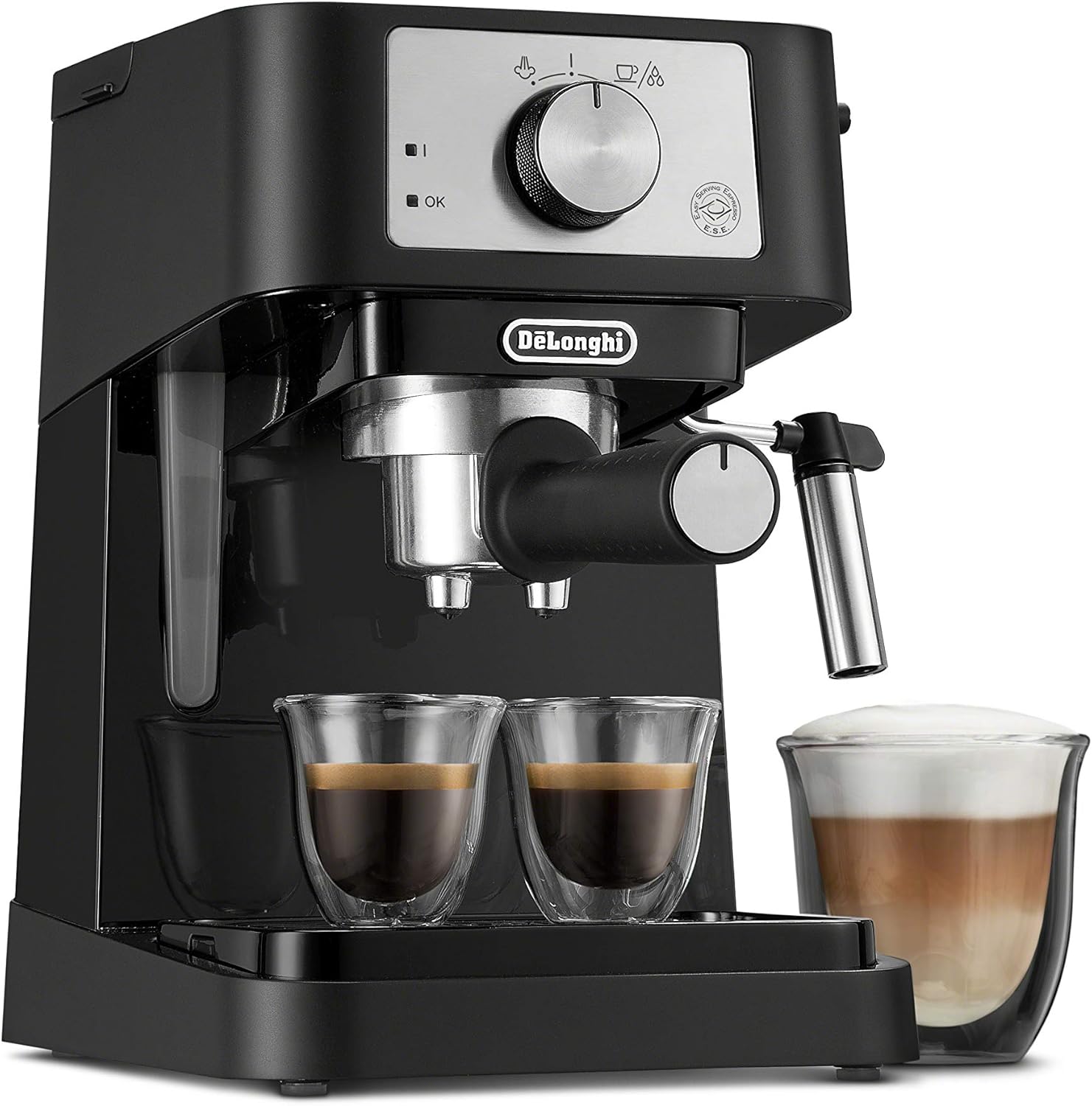
Here's what's actually happening under that compact shell. A single stainless steel boiler heats water to two different temperatures for two different jobs: cooler for pulling espresso through the 15 bar pump, hotter and turned to steam for texturing milk. The Stilosa doesn't have a separate boiler for each job, which is how it stays small enough to leave out on your counter permanently instead of storing it in a cabinet. The trade-off is timing: switch between brewing and steaming too quickly and the machine is still catching up to the new temperature, which is why the first shot after frothing, or the first froth after brewing, can come out cooler than the one after it. Wait the thirty seconds the dial asks for, and it settles. The portafilter is the other half of the story. It comes with two swappable filters, one for a single shot and one for a double, and a separate tamper so you're pressing the grounds evenly instead of guessing. That even pressure is what the 15 bar pump actually needs to do its job: uneven grounds mean the water finds the easy path and the shot pulls thin and fast no matter how good the pump is. And the frothing wand is fully manual, no auto-programs, no presets, just steam and your own hand angling the pitcher, which means the first cappuccino you make will look nothing like the tenth.
So you're not buying a machine that pulls a perfect shot for you, you're buying the actual parts of one, the pump, the boiler, the portafilter, and the job of learning to run them together. That cold-shot quirk isn't really a flaw, it's a rhythm: brew, then wait a beat, then steam, and the machine stops fighting you.
Who the De'Longhi Stilosa is for, and who should skip it
Worth it if
- you're new to espresso and want to learn on real equipment instead of pods
- you don't mind a short daily ritual over a fully automatic button press
- your kitchen counter space is limited
- you're okay hand-texturing milk rather than pressing a button for it
Skip it if
- you want espresso and frothed milk at the push of one button
- you want a machine built to run every day for a decade without fuss
- you're not willing to learn the timing between brewing and steaming
Not for anyone who wants espresso at the push of one button, no timing, no pitcher, no learning curve.
The De'Longhi Stilosa review verdict: is it worth it?
If you're the kind of person who likes to feel yourself getting better at something in the kitchen, this is a quiet yes, the shots really do improve week over week. If you want espresso the moment you press a button, with zero timing to learn and zero pitcher to angle, save yourself the frustration and look at a fully automatic machine instead.
Picture the actual trade you're making: no more idling in the drive-through line for a cappuccino you could make in the time it takes the milk to steam. Day one looks like burnt fingers on the portafilter and a shot that runs a little fast, day thirty looks like a rhythm you don't think about anymore. Thousands of owners rate it well for exactly that reason, though a meaningful slice mention it doesn't always hold up to years of daily use the way the stainless boiler promises, so treat it as a great starter machine rather than a lifetime one.
Amazon shoppers rate it 4.2 out of 5 across 13,815 ratings. That is their number, not ours.
Before you go
Are DeLonghi espresso machines any good?
Yes, for the price point they're a solid way to learn real espresso making, especially with the Stilosa's stainless steel boiler and 15 bar pump, though they ask more of you manually than a fully automatic machine would.
Which is better, Breville or DeLonghi?
Breville machines tend to add more automation and a higher price, while a DeLonghi like the Stilosa keeps things manual and compact, so the better one depends on whether you want to learn the process or skip straight to the drink.
Which is better, DeLonghi or Nespresso?
Nespresso uses pre-portioned pods for speed and consistency, while a DeLonghi machine like this uses ground coffee and a portafilter, trading convenience for control over the shot and the freedom to use any coffee you like.
What are the common DeLonghi problems?
The most reported issues are leaking around the steam wand and the boiler not always holding up to years of daily use, both worth knowing before you buy rather than after.
By the numbers
earn an unconditional yes at full priceOut of 261 kitchen products we have reviewed. This one is a yes with a condition attached.
Verdict datasetQuestion indexCC BY 4.0
Full spec sheet
| Other Special Features of the Product | Milk Frother |
|---|---|
| Coffee Maker Type | Espresso Machine |
| Specific Uses For Product | Espresso |
| Operation Mode | Manual |
| Wattage | 1100 watts |
| Voltage | 110 volts |
| Human Interface Input | Buttons |
| Output Pressure | 15 bar |
Head to head
Keep comparing


More kitchen reviews.
Wondering about the category itself? Is an Espresso Machine Worth It? Honest Answer