Is the Bear Rice Cooker Worth It for Small-Batch Rice?
Worth it, if you're cooking for one or two.
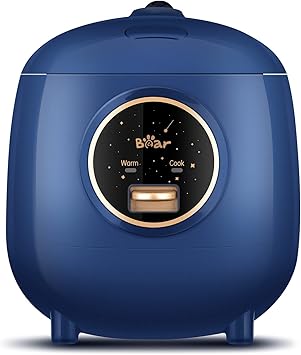
You've been there: a saucepan of rice for one person, the water hissing over the side, the bottom scorching while the top stays crunchy. You turn the heat down, then up, then down again, and still end up scraping burnt grains off the pan afterward. The Bear rice cooker exists for exactly this kind of small, annoying failure.
Here's the bit that actually matters: this cooker is built around portion size, not power. Its inner pot is a thickened, curved liner shaped so heat wraps around the rice rather than blasting up from one flat coil underneath, which is why stovetop pots burn on the bottom while the top stays undercooked. Bear calls it 3D heating, but the physics is simple: more of the pot surface touches heat, so the temperature evens out across two cups of rice in about twenty-five minutes. Because the batch is small, you press one button and walk away, no dial to babysit, no lid to lift and check, just a switch to keep warm once it's done so rice sitting there at six is still rice you'd want at seven. The nonstick liner and detachable inner lid mean the part that usually needs scrubbing, the scorched ring at the bottom, mostly lifts out with a rinse. An extended steam port sends the starchy overflow up and out instead of down your counter, which is the actual reason this survives a dorm shelf without staining.
So you're not really buying a rice cooker, you're buying back the twenty minutes you used to spend babysitting a pot for one. The size isn't a compromise, it's the entire feature: everything about the shape and heating is tuned to a small batch, which is exactly why it's fast and exactly why it won't scale up gracefully.
Worth it if
- You're cooking rice for one or two people most nights
- Counter space or storage is tight (dorm, RV, small kitchen)
- You want fewer buttons and no hovering over a stovetop pot
Skip it if
- You regularly cook for four or more people
- You want a machine that also handles soups, oatmeal, or steaming
- You want digital timers or delay-start programming
Not for anyone who regularly cooks rice for four or more people.
If you're cooking for one or two, in a dorm, small kitchen, or anywhere counter space is short, this is a quiet yes: set it, forget it, eat on time. If you regularly feed a family or batch-cook for the week, a larger multi-cup model will serve you better, this one's built to stay small.
Amazon shoppers rate it 4 out of 5 across 2,963 ratings. That is their number, not ours.
Before you go
Who makes Bear rice cookers?
Bear is a kitchen appliance brand known for compact, single-purpose cookers like this mini rice cooker, sold mainly through online marketplaces.
How do you use the Bear mini rice cooker?
Rinse your rice, add it with water up to the marked line using the included cup, then press the one-touch button; it cooks for about 25 minutes and switches to keep-warm automatically.
What is the rice to water ratio for a mini rice cooker?
Use the water markings inside the pot rather than a fixed ratio, since the built-in scale is calibrated to this cooker's exact heat and pot shape.
By the numbers
earn an unconditional yes at full priceOut of 266 kitchen products we have reviewed. This one is a yes with a condition attached.
Verdict datasetQuestion indexCC BY 4.0
Full spec sheet
| Brand | Bear |
|---|---|
| Capacity | 2 cups |
| Product Dimensions | 8.54"D x 8.54"W x 7.48"H |
| Power Source | Corded Electric |
| Product Care Instructions | Hand Wash, Dishwasher Safe |
Keep comparing
More Bear


More kitchen reviews.