Are tankless water heaters worth it for your home?
Worth it, if you size it right
Why your water heater tank keeps running out
Picture the last inch of a shower, water losing its heat just as you're rinsing the shampoo out, the tank downstairs quietly running dry mid scrub. That is the moment that makes people ask are tankless water heaters worth it, because a tank clearly has a ceiling, and the closet space it eats up the rest of the year doesn't help either.
How the Rheem 18kW tankless heater actually heats water
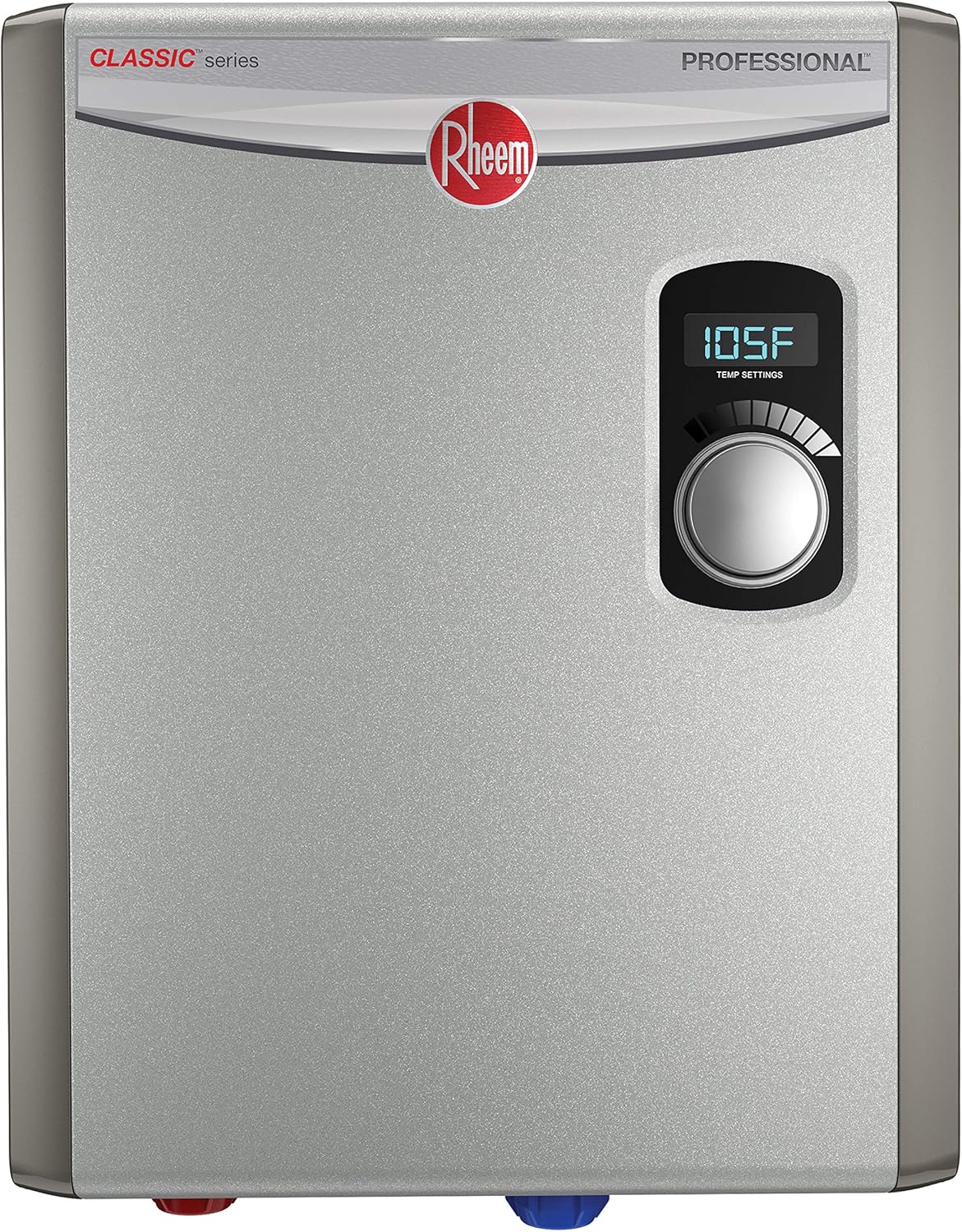
Under the sink or bolted to a wall, this Rheem swaps a fifty gallon tank for something the size of a briefcase, and that swap is the whole story. A tank heats and reheats water around the clock so it's ready the second you turn the tap; the Rheem's copper immersion elements only fire when water is actually moving through the unit, sensed by flow and pushed by the digital thermostat to hold within one degree of your setpoint. That self-modulating trick, drawing exactly the power the demand calls for instead of running full tilt around the clock, is where the energy savings actually come from, not marketing gloss. The trade is flow rate: 4.4 GPM through the 18kW element is enough for one shower running comfortably, maybe a shower and a slow filling sink, but ask it for two showers and a dishwasher at once and the incoming cold water simply dilutes what comes out the other end. The 240 volt hookup and bottom three quarter inch NPT connections keep installation straightforward if your panel has room for the load, and the elements are field serviceable, which matters more than it sounds, because a heating element that fails in year two is a swap, not a whole new unit. Size the GPM to your actual simultaneous demand, not your square footage, and the mechanism does exactly what it promises.
You're not buying endless hot water, you're buying a flow rate ceiling that never runs cold within that ceiling. Match your simultaneous demand to the 4.4 GPM the copper elements can push, and the standby losses of a tank disappear along with the tank itself. Ask more of it than that, and you're just trading one kind of running out for another.
Who this tankless heater fits, and who it doesn't
Worth it if
- you need hot water for one bathroom or a single point-of-use fixture
- space is tight and you want the tank closet back
- you want to stop paying to keep a tank hot when nobody's using it
Skip it if
- you're heating a whole house through cold winters
- two or more showers or major fixtures run at the same time
- you want a set-and-forget appliance with no field maintenance
Not for whole-house demand in cold climates or homes that need two showers running at once.
Is a tankless water heater worth it: the Rheem verdict
If you've got one bathroom, a point of use need, or a tight utility space, this is a quiet yes, it'll hand you hot water on demand and give you the closet back. If you're heating a whole house through cold winters or running two showers at once, size up or look elsewhere, this unit was never built for that math.
The wait and hope shower is gone. Day one, you turn the tap and the LED holds steady while the water just arrives, no tank rumbling downstairs and no closet lost to it. A very large number of owners land on the same trade: plenty of hot water for what they actually use it for, with a smaller but real share finding the heat output uneven or the elements wearing sooner than they'd like. Size it right and that second group mostly isn't you.
Amazon shoppers rate it 4.2 out of 5 across 2,180 ratings. That is their number, not ours.
Before you go
What are the downsides to a tankless water heater?
Flow rate caps at 4.4 GPM, so temperature drops when running multiple fixtures. Installation requires a dedicated high-amp 240 volt circuit.
Can you run two showers with a tankless water heater?
No, not comfortably. This 18kW unit's 4.4 GPM flow is sized for one shower; a second shower will dilute temperature for both.
How much is a tankless water heater for a 2000 square foot house?
Cost depends on flow rate needed, not square footage. A 2000 sq ft house typically needs a higher kW unit or two units, costing more than this single model.
Why don't plumbers like tankless water heaters?
Installation often requires upgrading electrical service for high-amp 240 volt draw, requiring more labor than tank replacement. Repairs need specialized expertise.
By the numbers
earn an unconditional yes at full priceOut of 158 home & garden products we have reviewed. This one is a yes with a condition attached.
Verdict datasetQuestion indexCC BY 4.0
Full spec sheet
| Power Source | AC Power |
|---|---|
| Special Features | LED Display |
| Wattage | 18000 watts |
| Voltage | 240 volts |
| Flow Rate | 4.4 gpm |
| Maximum Temperature | 140 °F |
| Heat Output | 18 KW |
| Efficiency | 99.8% |
Keep comparing


More home & garden reviews.