Are robot vacuums really worth it for your home?
Worth it, with a floor-type caveat
Why the floor never quite stays clean
You know the moment: you finally get a spare hour, get down on your knees with a rag to catch the crumbs under the kitchen table, and the dog walks straight across the spot you just wiped. It's the fourth time this week you've wondered, quietly, are robot vacuums worth it, standing there with wet knees and a rag that smells like the mop bucket. The question was never whether a machine can vacuum. It's whether it can do the actual chore, the mopping, the corners, the dog hair, without you standing over it the whole time.
How a robot vacuum and mop combo actually cleans
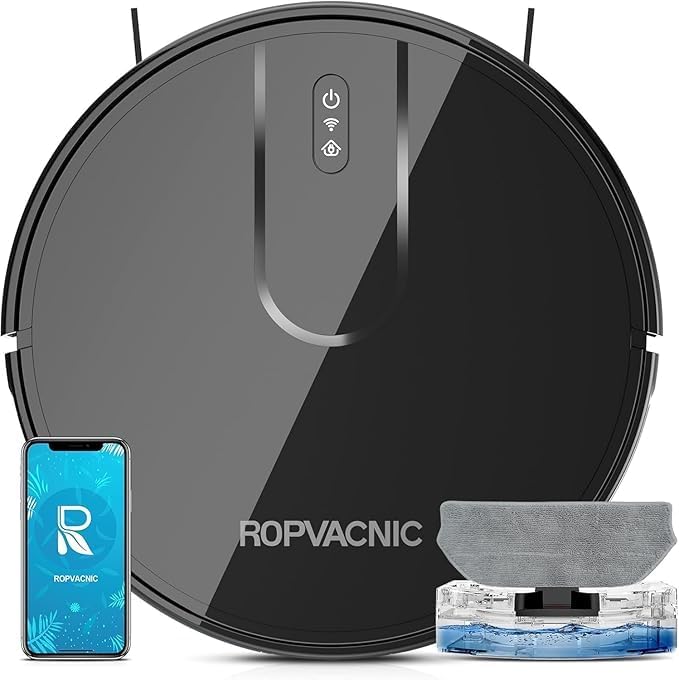
Here's what I'd want to know first: the mop and the vacuum on this thing aren't separate jobs bolted together, they're run off the same water tank through an electronically controlled valve. That valve is the whole trick. Instead of a pad that's either soaked or dry, it doles out water in four stages, so a light pass keeps hardwood from swelling while a heavier setting goes after the sticky spot by the stove. You pick the stage once, in the app, and it holds that setting room to room, which is the bit the listing buries: you're not refilling or wringing anything mid-clean. The suction side works the same way, in layers rather than one blast. At 5200Pa with three suction levels, it can back off on hardwood and step up on a low-pile rug without you flipping a switch, because the sensing system that steers it around furniture legs is also reading the floor underneath. And the part that actually matters if you own an animal: there's no central roller brush to catch hair at all. Two side brushes rotate hair and crumbs into the intake instead of winding it around an axle, which is the whole reason you won't be cutting hair out of it with scissors every other week. Scheduling and voice control, it answers to Alexa or Google, mean the cleaning happens on a clock you set once, and when the battery runs low around the two hour mark, it finds its own way back to the dock and charges itself for the next run. None of that requires you to be home, which is the actual point of owning one.
So here's the reframe: you're not buying a vacuum, you're buying back the kneeling. The suction and the mopping are just how it gets there. Whether it's worth it comes down to one thing, whether your floors are the kind it was built for, mostly hardwood and low-pile carpet, and whether you're willing to let go of doing that chore yourself.
Who the ROPVACNIC robot vacuum is for, and who should skip it
Worth it if
- your home is mostly hardwood or low-pile carpet
- you want mopping and vacuuming handled on one schedule
- you have pet hair to manage daily
- you'd rather set a schedule once than remember to clean
Skip it if
- you have thick or high-pile rugs it can get stuck on
- your home has loose cords or low furniture it can wedge under
- you live in a multi-level home without a robot per floor
- you want precise room mapping over broad coverage
Not for homes with thick rugs, loose cords, or stairs it would need to climb on its own.
Is a robot vacuum worth it: the verdict
If your home is mostly hardwood or low-pile carpet and you're tired of mopping being its own separate chore, this is a quiet yes; set the schedule once and stop thinking about it. If you've got thick rugs, a lot of loose cords, or a house with stairs it would need to climb, skip it, the design that makes it good at floors makes it bad at edges and thresholds it can't get over.
What this actually removes from your day is the kneeling, the rag, the guilt about the crumbs under the table you keep meaning to get to. Picture coming home to floors that were vacuumed and mopped while you were out, the robot already docked and charging like nothing happened. A wide base of owners land on the same read, that it earns its keep on daily crumbs and pet hair and runs quietly enough to forget about, even if a few find its sense of the room less exact than they'd like. That's a fair trade for the chore it takes off your plate.
Amazon shoppers rate it 4.3 out of 5 across 1,648 ratings. That is their number, not ours.
Before you go
What are the downsides of robot vacuums?
Getting stuck on thick rugs or cords, needing fairly clear floors, and imperfect mapping.
Is it worth buying a robot vacuum cleaner?
Yes, if your floors are mostly hardwood or low-pile carpet; less useful on thick carpet or cluttered floors.
How many times a week should I run a robot vacuum?
Daily or every other day on a schedule handles crumbs and pet hair better than weekly cleaning.
What is the #1 robot vacuum?
No single model works best for every home; the right choice depends on floor type, pets, and mapping needs.
By the numbers
earn an unconditional yes at full priceOut of 254 kitchen products we have reviewed. This one is a yes with a condition attached.
Verdict datasetQuestion indexCC BY 4.0
Full spec sheet
| Surface Recommendation | Hardwood Floors, Low Pile Carpets |
|---|---|
| Other Special Features of the Product | Adjustable Electric Mopping➤Intelligent Auto Docking➤Advanced Obstacle Avoidance➤5200Pa… |
| Controller Type | App Control, Remote Control, Touchpad Control, Voice Control |
| Filter Type | Multi-layer Optimized High-Efficiency Filtration |
| Battery Life | 120 minutes |
| Battery Type | Lithium Ion |
| Power Source | Battery Powered |
| Control Method | App, Remote, Voice |
Keep comparing


More kitchen reviews.