Are Athlon scopes any good, or just good on paper?
Worth it, with conditions
Why the glass looks soft at max zoom
You dial the turret back to zero, hear it click into something that feels like a real wall, and let out a breath you didn't know you were holding. Then you crank the power ring up to 24x and the target goes a little soft at the edges, and you're left wondering if that's the glass or your eye. That's the moment every shooter looking at the Argos BTR GEN2 lands on: are Athlon scopes any good, or are you paying for a badge on an aluminum tube.
How the Argos BTR GEN2's turrets and reticle actually work
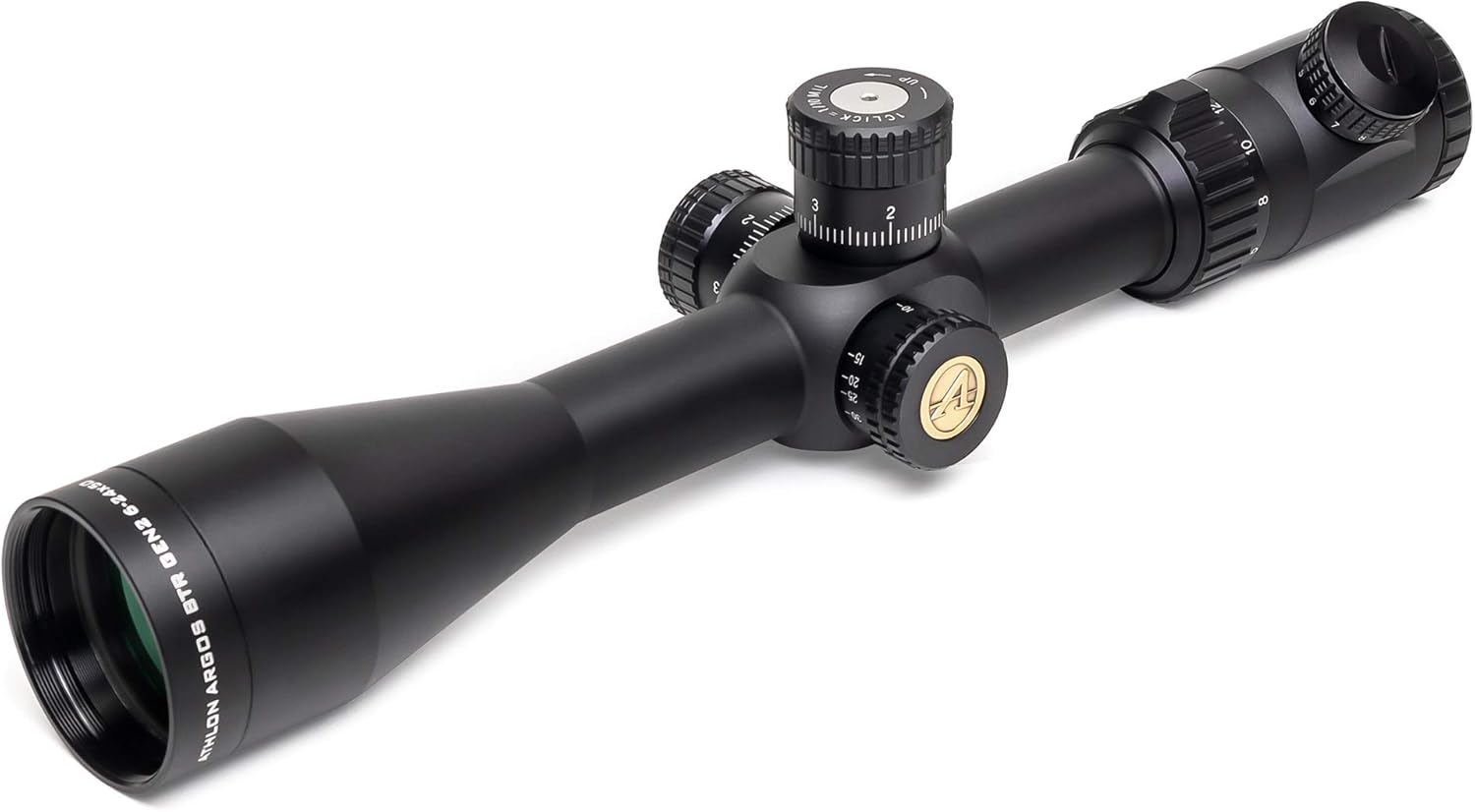
Here's what's actually happening under the turret caps. The reticle sits on the first focal plane, etched onto a lens group that moves with the magnification instead of staying fixed behind it. Zoom from 6x to 24x and the crosshair grows or shrinks with your target, so a mil reading at 8x still reads correctly at 20x. That matters the moment you're ranging on the clock, because you're reading the reticle and holding, not doing magnification math in your head. The turrets click in 0.1 MIL increments across 18 MILs of total travel, which is Athlon's way of saying the dial does the work a lot of scopes leave to you. Dial to zero and the Precision Zero Stop physically locks the turret at that mark, a mechanical wall you can find with your thumb in bad light or none at all. That's the gap between a scope you trust mid-stage and one you're double-checking every position. Parallax runs from ten yards to infinity through a side-focus dial, so you're adjusting the glass instead of chasing a blurry reticle by moving your head around. And the fully multi-coated optics with the XPL lens coating do quieter work underneath all of it: more light making it through the tube instead of bouncing off the lens surfaces, and a lens face that sheds rain, grease and range dust instead of holding onto it.
So the honest answer to are Athlon scopes any good is that this one behaves like a scope built for the discipline, not the display case. You're not buying magnification, you're buying a dial you can trust blind and a reticle that tells the truth at every zoom setting. Whether that's worth it comes down to whether you shoot enough to actually need that trust.
Who the Argos BTR GEN2 is for, and who should skip it
Worth it if
- you're getting into PRS or precision rifle matches and need a reticle that reads true at every zoom setting
- you want a mechanical zero stop you can find by feel in bad light
- you shoot at variable ranges and need reliable parallax adjustment down to ten yards
Skip it if
- you're mounting a scope for a single fixed-distance hunt and won't touch the turrets
- you need edge-to-edge clarity at full 24x for load development
- you want the lightest possible optic for a mountain hunt
Not for a once-a-year fixed-distance hunt where you'll never touch the turrets.
Are Athlon scopes any good: the Argos BTR GEN2 verdict
If you're stepping into PRS or precision hunting and want turrets and a reticle system that won't lie to you mid-stage, this is a quiet yes. If you're mounting a scope for a once-a-season deer hunt at a hundred yards, you don't need first focal plane math or an 18 MIL zero stop, save the money for something simpler.
That soft edge at 24x you were worried about? Most range days you're working somewhere in the 10 to 16x window anyway, right where this glass is at its best, and the zero stop means the first shot of the day is exactly where you left it. Mount it, dial to zero, feel that mechanical stop click home, and stop thinking about your equipment so you can think about your position and your breathing.
Amazon shoppers rate it 4.6 out of 5 across 301 ratings. That is their number, not ours.
Before you go
Which is better, Athlon or Vortex scopes?
Both build scopes at similar price points with mechanically similar features like exposed turrets and zero stops, so the real difference usually comes down to glass clarity at your preferred magnification and which company's warranty support you trust more.
Which scope is better, Leupold or Athlon?
Leupold generally sits at a higher price with a longer optical track record, while Athlon's PRS-oriented lines like the Argos BTR GEN2 pack in features like first focal plane reticles and zero stops that used to only show up on scopes well above this price.
Are Athlon scopes good quality?
Yes, generally, Athlon scopes are built around an aircraft grade aluminum tube and coated glass that hold zero and track accurately, though optical clarity at the extreme top of the zoom range can vary scope to scope.
What are common problems with Athlon scopes?
The most reported issue is softness or blur at maximum magnification, in this model's case up around 20 to 24x, along with occasional inconsistency in illumination brightness and turret dial feel.
By the numbers
earn an unconditional yes at full priceOut of 157 sports & outdoors products we have reviewed. This one is a yes with a condition attached.
other reviews field the same questionAre Athlon scopes good quality?
comes up across our sports & outdoors coverage, not just here — one of the things worth settling before you choose.
Verdict datasetQuestion indexCC BY 4.0
Full spec sheet
| Magnification Maximum | 4 x |
|---|---|
| Objective Lens Diameter | 50 millimeters |
| Magnification Minimum | 6 x |
| Compatible Devices | Rifle |
| Mounting Type | Pivot |
| Reticle Type | First Focal Plane |
| Item Weight | 1.9 pounds |
| Color | Black |


